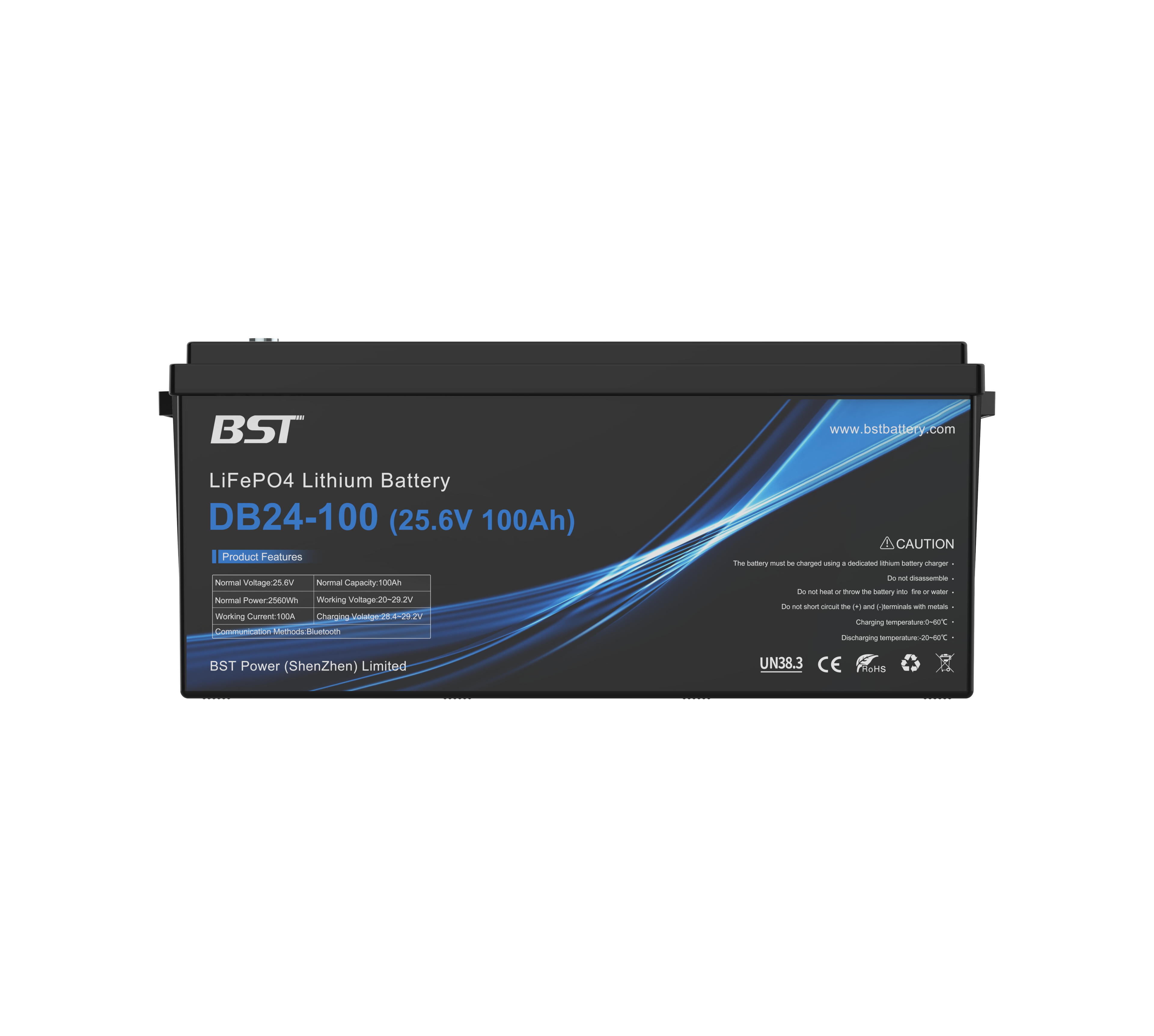
24V B2B storage platform
24V 100Ah LiFePO4 Battery
A 2.56kWh 24V reference platform for off-grid solar, mobile equipment and auxiliary systems that benefit from higher voltage than a 12V bank.
Ask for the current data sheet, sample terms and final configuration before purchase.
Technical reference
24V 100Ah LiFePO4 battery specifications
The battery's stated nominal voltage is 25.6V, commonly described as a 24V-class battery. Review it only with compatible system components and final product documentation.
| Cell chemistry | LiFePO4 |
|---|---|
| Nominal voltage / capacity | 25.6V / 100Ah (minimum capacity listed as 98Ah) |
| Nominal energy | 2.56kWh |
| Charge voltage / standard charge current | 29.2V / 20A |
| Maximum continuous / peak discharge | 100A / 150A for 1 second |
| Discharge cut-off voltage | 20.0V |
| Charge / discharge temperature | 0 to 45C / -20 to 45C |
| Ingress rating / flame class | IP66 / UL94-HB |
| Connection architecture | Up to 2 in series and 4 in parallel, using matched approved modules |
| Communication / terminals | Bluetooth app communication / M8 |
| Dimensions / approximate weight | 520 × 237 × 221mm / 20kg |
Where it fits
Use 24V architecture to design the system, not just the battery.
For many off-grid applications, a 24V platform can reduce current in the DC wiring compared with equivalent power at 12V. That benefit only exists when the rest of the system is designed at 24V and each interface is checked.
- Off-grid solar: check controller, inverter and charge-voltage compatibility.
- Mobile equipment: compare current profile, physical mounting and shock/environment requirements.
- Expandable systems: follow the approved 2S/4P architecture and matched-module instructions.
Buyer FAQ
Questions for a 24V LiFePO4 battery project
Is 25.6V the same as a 24V battery?
It is normally used as a 24V-class LiFePO4 battery. The system must still be designed around its actual charge, discharge and protection-voltage limits, not a generic 24V label.
Can I combine this with a 12V battery?
Do not combine batteries of different voltages, capacities, types, configurations or brands in the same series/parallel bank. Plan one approved architecture from the outset.
What determines the right capacity?
Capacity follows the energy budget, required autonomy, depth-of-discharge strategy, temperatures and expected future load. Share a load list rather than selecting only by a familiar amp-hour figure.
Can I request custom communication or branding?
For an OEM/private-label project, state the required communications, product appearance, labels, packaging and target-market requirements at briefing stage so feasibility can be assessed against the selected platform.
Start with a system brief
Let voltage, loads and charging sources lead the product choice.
Give the project context and receive a more useful commercial conversation.